
Introduction
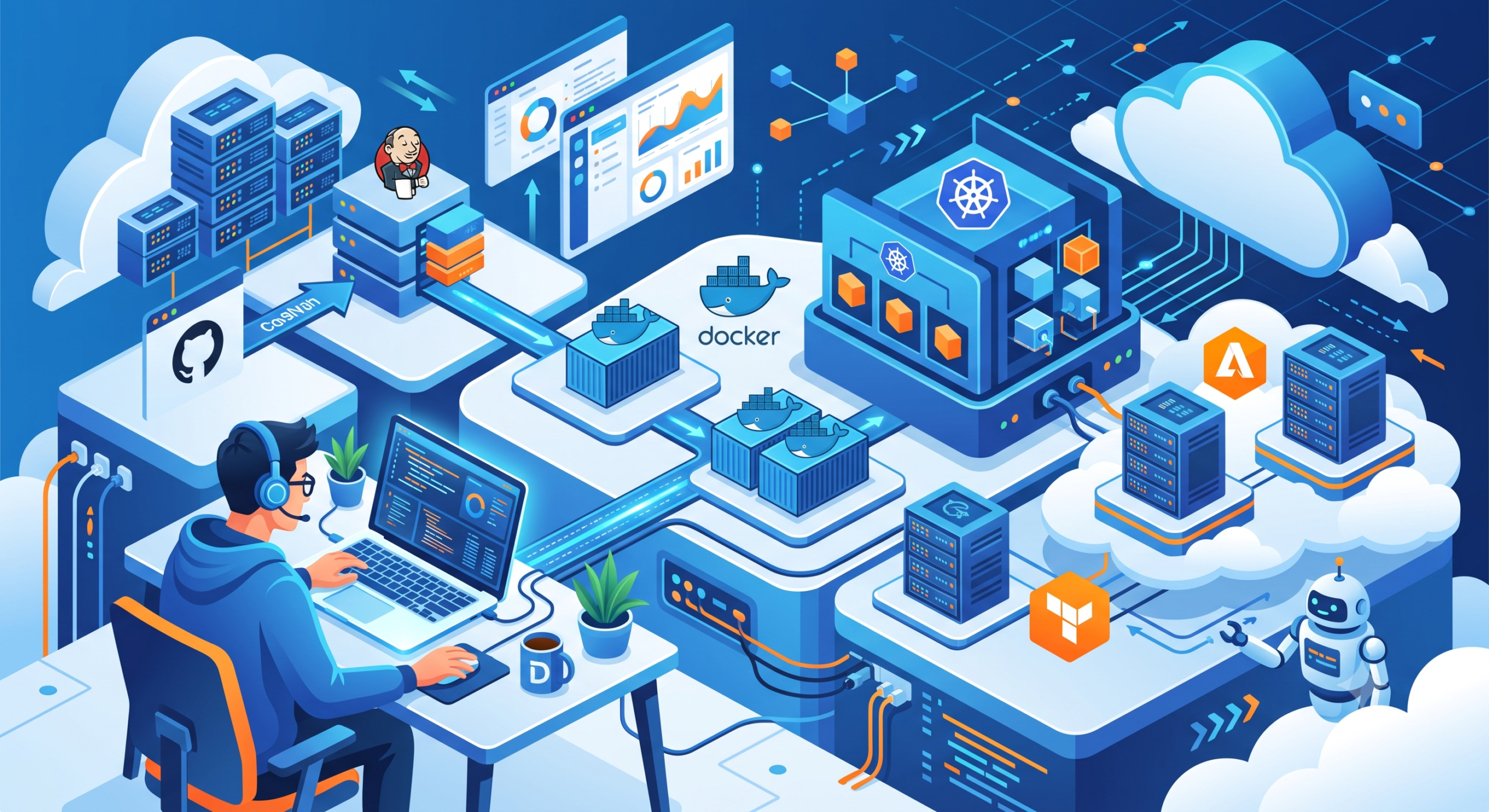
Cloud computing has completely transformed the technology industry. Almost every modern organization, from startups to Fortune 500 companies, relies on cloud infrastructure to host applications, store data, improve scalability, and reduce operational costs. At the same time, businesses are expected to deliver software updates faster than ever before. These changes have created two of the most in-demand careers in IT: Cloud Engineers and DevOps Engineers.
One of the most common questions among students and professionals entering the cloud domain is Cloud Engineer vs DevOps Engineer. Although these roles share many tools and technologies, they are not identical. Understanding the differences can help you choose a career that aligns with your interests, strengths, and long-term goals.
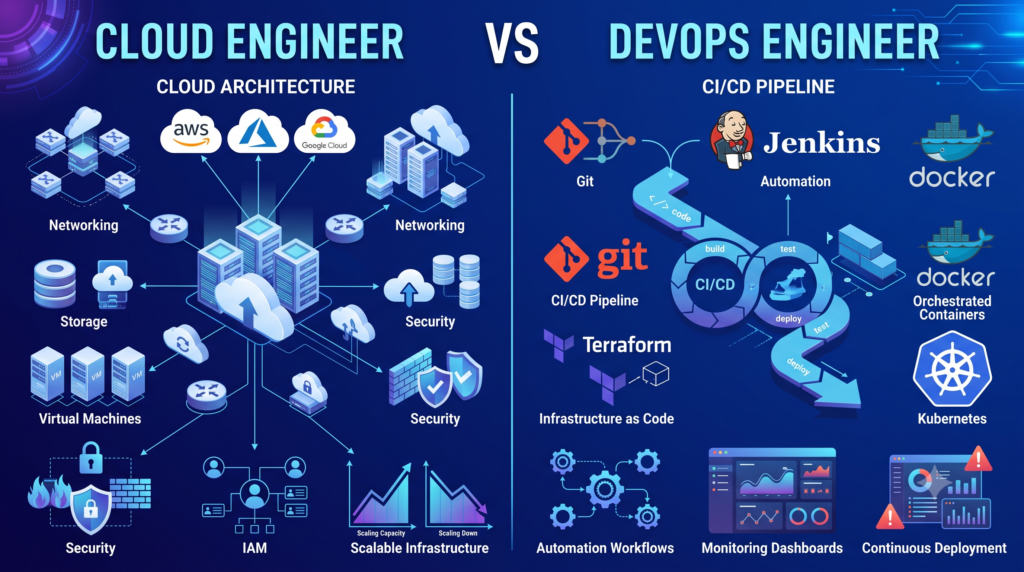
Many beginners assume that both professionals perform the same work because they use AWS, Azure, Docker, Kubernetes, Linux, Terraform, and other modern technologies. In reality, their objectives are different. A Cloud Engineer focuses primarily on building and maintaining reliable cloud infrastructure, while a DevOps Engineer concentrates on automating software delivery and improving collaboration between development and operations teams.
This detailed guide explains every important aspect of Cloud Engineer vs DevOps Engineer, including daily responsibilities, required technical skills, salary expectations, certifications, career opportunities, and the future of both professions.
Whether you are a college student, a working professional, or someone planning a career switch into cloud computing, this guide will help you make an informed decision.
Table of Contents
Why This Comparison Matters
The demand for cloud professionals continues to rise every year. Organizations are migrating applications from traditional on-premises data centers to cloud platforms because cloud services provide flexibility, high availability, disaster recovery, and cost optimization.
At the same time, companies want faster software releases without sacrificing quality. This is where DevOps practices have become essential. Businesses now automate testing, deployment, monitoring, and infrastructure provisioning to release software several times a day instead of once every few months.
Because of these industry changes, both Cloud Engineers and DevOps Engineers enjoy excellent salaries and career growth. However, choosing the wrong learning path can waste months of effort.
Learning the differences between Cloud Engineer vs DevOps Engineer allows you to:
- Select the right career path based on your interests.
- Build the correct technical skills from the beginning.
- Choose appropriate certifications.
- Prepare for interviews more effectively.
- Increase your chances of securing high-paying jobs.
What Is a Cloud Engineer?
A Cloud Engineer is an IT professional responsible for designing, deploying, managing, securing, and maintaining cloud infrastructure. Their work ensures that applications and services remain available, scalable, and secure.
Instead of managing physical servers inside an organization’s data center, Cloud Engineers create infrastructure using cloud providers such as Amazon Web Services (AWS), Microsoft Azure, and Google Cloud Platform (GCP).
Their primary goal is to build cloud environments that are reliable, cost-effective, and capable of supporting business applications under varying workloads.
Cloud Engineers also work closely with networking teams, security teams, software developers, and system administrators to ensure cloud resources are configured correctly.
Primary Responsibilities of a Cloud Engineer
A Cloud Engineer performs several important tasks throughout the software lifecycle.
Designing Cloud Architecture
One of the biggest responsibilities is designing scalable cloud architecture capable of handling increasing user traffic without performance issues.
This includes selecting the appropriate cloud services, configuring networking, implementing storage solutions, and ensuring fault tolerance.
Infrastructure Deployment
Cloud Engineers deploy virtual machines, managed databases, storage services, Kubernetes clusters, serverless applications, and networking resources.
Rather than manually creating infrastructure every time, they often use Infrastructure as Code tools like Terraform or AWS CloudFormation.
Identity and Access Management
Security is one of the highest priorities in cloud computing.
Cloud Engineers configure IAM users, groups, roles, permissions, multi-factor authentication, and least-privilege access policies to protect organizational resources.
Networking Configuration
Cloud networking involves:
- Virtual Private Clouds (VPCs)
- Public and Private Subnets
- Route Tables
- Internet Gateways
- NAT Gateways
- VPN Connections
- DNS
- Load Balancers
- Security Groups
- Network ACLs
A Cloud Engineer must understand how these components work together to create secure communication between cloud resources.
Storage Management
Cloud Engineers configure storage solutions for different business requirements.
Examples include:
- Object Storage
- Block Storage
- File Storage
- Database Storage
- Backup Storage
- Archive Storage
Choosing the correct storage solution directly affects performance and cost.
Monitoring and Performance Optimization
Cloud Engineers continuously monitor infrastructure health using monitoring services and dashboards.
Typical monitoring includes:
- CPU utilization
- Memory usage
- Disk performance
- Network traffic
- Application health
- Security alerts
- Resource utilization
Monitoring enables teams to identify issues before customers experience outages.
Cost Optimization
Cloud services follow a pay-as-you-go pricing model.
Without proper planning, organizations can spend thousands of dollars unnecessarily.
Cloud Engineers regularly optimize:
- Compute resources
- Storage costs
- Reserved instances
- Auto Scaling
- Resource scheduling
- Unused infrastructure
Cost optimization has become one of the most valuable cloud engineering skills.
Essential Skills Required for a Cloud Engineer
A successful Cloud Engineer needs expertise across multiple technical domains.
Cloud Platforms
The most popular cloud providers include:
- Amazon Web Services (AWS)
- Microsoft Azure
- Google Cloud Platform (GCP)
Most companies prefer candidates with strong AWS knowledge because AWS currently holds the largest cloud market share.
Linux Administration
Since many cloud workloads run on Linux servers, Cloud Engineers should understand:
- File systems
- User management
- Permissions
- Process management
- Package installation
- Shell scripting
- Cron jobs
- SSH
- Networking commands
Linux remains one of the most important skills for cloud professionals.
Networking
Networking knowledge separates average cloud engineers from excellent ones.
Important concepts include:
- TCP/IP
- DNS
- HTTP/HTTPS
- SSL
- Routing
- Firewalls
- VPN
- CIDR
- NAT
- Load Balancers
Networking interviews are common for cloud engineering roles.
Infrastructure as Code
Modern infrastructure is rarely created manually.
Cloud Engineers use Infrastructure as Code tools such as:
- Terraform
- AWS CloudFormation
- Azure Resource Manager (ARM)
- Pulumi
Infrastructure automation improves consistency, scalability, and disaster recovery.
Containerization
Containers have become the standard deployment method.
Cloud Engineers should understand:
- Docker
- Container Images
- Registries
- Docker Compose
- Kubernetes Basics
Containers simplify application deployment across multiple environments.
Security
Cloud security includes:
- IAM
- Encryption
- Secrets Management
- Key Management
- Compliance
- Logging
- Security Monitoring
- Vulnerability Management
Organizations prioritize security because cloud infrastructure often stores sensitive customer information.
Popular Tools Used by Cloud Engineers
A Cloud Engineer commonly works with the following technologies:
- AWS EC2
- Amazon S3
- Amazon RDS
- AWS Lambda
- AWS IAM
- Amazon CloudWatch
- AWS CloudFormation
- Azure Virtual Machines
- Azure Storage
- Azure Monitor
- Google Compute Engine
- Terraform
- Docker
- Kubernetes
- Linux
- Git
- Prometheus
- Grafana
- Ansible
Learning these tools builds a strong foundation for a successful cloud engineering career.
Cloud Engineer Career Path
A typical Cloud Engineer career progression looks like this:
- IT Support Engineer
- Linux Administrator
- System Administrator
- Junior Cloud Engineer
- Cloud Engineer
- Senior Cloud Engineer
- Cloud Consultant
- Cloud Architect
- Principal Cloud Architect
With experience, professionals can also specialize in cloud security, networking, site reliability engineering, or cloud solution architecture.
The rapid adoption of cloud technologies means demand for skilled Cloud Engineers continues to grow across industries including banking, healthcare, e-commerce, education, gaming, fintech, and government organizations.
In the next section, we’ll explore what a DevOps Engineer does, compare Cloud Engineer vs DevOps Engineer in depth, examine salaries, required tools, certifications, and help you decide which career is the better fit.
What Is a DevOps Engineer?
A DevOps Engineer is responsible for bridging the gap between software development and IT operations. Instead of focusing only on infrastructure, a DevOps Engineer works to automate the entire software delivery lifecycle, ensuring applications move from development to production quickly, securely, and reliably.
The word DevOps combines Development and Operations. Traditionally, developers wrote code while operations teams handled deployments and infrastructure. This separation often caused delays, deployment failures, and communication problems.
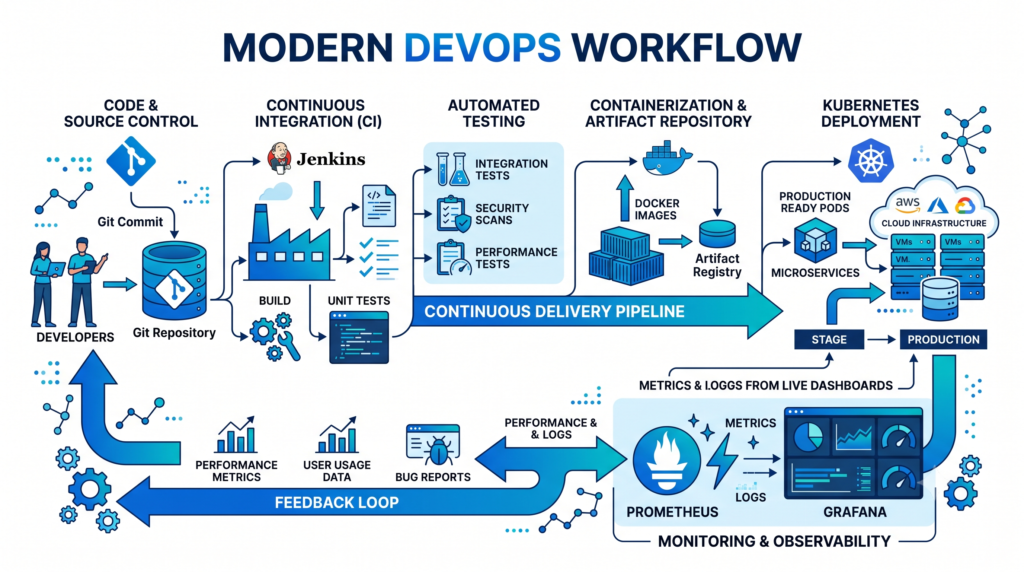
Modern organizations have adopted DevOps practices to solve these issues. A DevOps Engineer builds automated pipelines, manages infrastructure as code, monitors applications, improves deployment speed, and ensures continuous integration and continuous delivery (CI/CD).
When discussing Cloud Engineer vs DevOps Engineer, this is one of the biggest distinctions. A Cloud Engineer primarily builds and manages cloud infrastructure, while a DevOps Engineer focuses on automating software development and deployment workflows.
Responsibilities of a DevOps Engineer
A DevOps Engineer performs a wide range of responsibilities across the software development lifecycle.
Building CI/CD Pipelines
One of the primary responsibilities is creating Continuous Integration and Continuous Deployment (CI/CD) pipelines.
Instead of manually deploying software, developers push their code to Git repositories. Automated pipelines then:
- Build the application
- Run automated tests
- Scan for vulnerabilities
- Package the application
- Deploy to staging
- Perform quality checks
- Deploy to production
Automation reduces human errors and accelerates software delivery.
Infrastructure Automation
Modern DevOps Engineers rarely create servers manually.
Using Infrastructure as Code (IaC), they provision complete cloud environments using tools such as Terraform and Ansible.
This enables organizations to recreate infrastructure within minutes rather than hours.
Containerization
Applications today are commonly deployed inside containers.
A DevOps Engineer works extensively with:
- Docker
- Docker Compose
- Kubernetes
- Helm
- Container Registries
Containers ensure applications behave consistently across development, testing, and production environments.
Monitoring Applications
Deploying software is only the beginning.
DevOps Engineers continuously monitor:
- Server health
- Application performance
- CPU usage
- Memory utilization
- Network latency
- Error rates
- Response times
- Logs
Monitoring allows teams to identify problems before customers notice them.
Configuration Management
Managing hundreds or thousands of servers manually is impossible.
DevOps Engineers use tools like:
- Ansible
- Puppet
- Chef
These tools automate server configuration and maintain consistency across environments.
Security Integration
Modern DevOps includes DevSecOps practices.
Security checks are integrated directly into deployment pipelines.
Examples include:
- Dependency scanning
- Secret scanning
- Container image scanning
- Infrastructure scanning
- Compliance validation
- Vulnerability assessments
Security becomes everyone’s responsibility rather than only the security team’s responsibility.
Essential Skills Required for a DevOps Engineer
Successful DevOps Engineers possess technical expertise across multiple domains.
Linux
Linux remains one of the most important DevOps skills.
Topics include:
- Shell scripting
- Process management
- File permissions
- Networking
- User administration
- Package management
Git
Version control is fundamental.
Every DevOps Engineer should understand:
- Branches
- Merging
- Pull Requests
- Rebasing
- Conflict Resolution
- Git Workflows
CI/CD Tools
Popular tools include:
- Jenkins
- GitHub Actions
- GitLab CI/CD
- Azure DevOps
- CircleCI
- Argo CD
Understanding pipeline creation is essential.
Containers
Container technologies include:
- Docker
- Kubernetes
- Helm
- OpenShift
Kubernetes knowledge significantly increases employability.
Cloud Platforms
Although DevOps Engineers focus on automation, they still require cloud knowledge.
Popular platforms include:
- AWS
- Azure
- Google Cloud Platform
Cloud services frequently appear inside deployment pipelines.
Programming and Scripting
Automation requires scripting.
Popular languages include:
- Bash
- Python
- PowerShell
- Go (optional)
Programming helps automate repetitive operational tasks.
Monitoring
Monitoring tools include:
- Prometheus
- Grafana
- ELK Stack
- Loki
- Datadog
- New Relic
These tools help maintain application reliability.
Popular DevOps Tools
A modern DevOps Engineer commonly uses:
- Git
- GitHub
- GitLab
- Jenkins
- Docker
- Kubernetes
- Helm
- Terraform
- Ansible
- AWS
- Azure
- Prometheus
- Grafana
- ELK Stack
- SonarQube
- Nexus Repository
- Argo CD
The DevOps ecosystem continues to evolve rapidly, making continuous learning an essential part of the profession.
Cloud Engineer vs DevOps Engineer: Major Differences
Although both careers overlap significantly, understanding Cloud Engineer vs DevOps Engineer becomes easier when comparing their objectives.
| Feature | Cloud Engineer | DevOps Engineer |
|---|---|---|
| Primary Goal | Build and maintain cloud infrastructure | Automate software delivery |
| Main Focus | Infrastructure | Development and Operations |
| Works With | Cloud Services | CI/CD Pipelines |
| Automation | Infrastructure Automation | Complete Software Automation |
| Programming | Moderate | Moderate to High |
| Infrastructure | Core Responsibility | Shared Responsibility |
| CI/CD | Basic to Moderate | Advanced |
| Kubernetes | Frequently Used | Extensively Used |
| Docker | Common | Essential |
| Monitoring | Infrastructure Monitoring | Infrastructure + Application Monitoring |
| Collaboration | Infrastructure Teams | Developers, QA, Security, Operations |
Cloud Engineer vs DevOps Engineer: Daily Responsibilities
A Cloud Engineer generally starts the day by reviewing infrastructure health, monitoring cloud resources, checking security alerts, and ensuring that applications are running on a stable and scalable cloud environment. They may provision new virtual machines, optimize storage, configure networking, or troubleshoot cloud-related issues.
A DevOps Engineer, on the other hand, often begins by reviewing deployment pipelines, monitoring build failures, checking application logs, and improving automation workflows. They collaborate closely with developers to ensure software releases happen smoothly and without downtime.
This distinction highlights an important aspect of Cloud Engineer vs DevOps Engineer. One role is centered around infrastructure reliability, while the other emphasizes software delivery efficiency.
Cloud Engineer vs DevOps Engineer: Required Technical Knowledge
Both roles require overlapping technologies, but the depth of knowledge differs.
A Cloud Engineer needs stronger expertise in:
- Cloud Architecture
- Networking
- Security
- Identity Management
- Storage Services
- Disaster Recovery
- High Availability
A DevOps Engineer needs deeper expertise in:
- CI/CD Pipelines
- Automation
- Git Workflows
- Kubernetes
- Deployment Strategies
- Monitoring
- Software Development Lifecycle
Professionals often transition between these roles because many technologies are shared.
Cloud Engineer vs DevOps Engineer: Which Role Is More Challenging?
There is no universal answer.
Cloud Engineering becomes challenging because infrastructure design requires extensive networking, security, scalability, and cost optimization knowledge.
DevOps Engineering becomes challenging because it combines software development, infrastructure, automation, monitoring, testing, and deployment into one role.
When evaluating Cloud Engineer vs DevOps Engineer, the better choice depends on your interests.
If you enjoy designing cloud infrastructure and solving networking problems, Cloud Engineering may suit you better.
If you enjoy automation, scripting, deployment pipelines, and improving software delivery, DevOps Engineering is likely the better option.
Comparison Summary
Here are the biggest differences between Cloud Engineer vs DevOps Engineer:
- Cloud Engineers focus on infrastructure.
- DevOps Engineers focus on automation.
- Cloud Engineers build cloud environments.
- DevOps Engineers automate software delivery.
- Both require Linux knowledge.
- Both require cloud platform expertise.
- Both frequently use Docker and Kubernetes.
- Both are among the highest-paying careers in modern IT.
- Both continue to experience strong global demand.
- Learning one role makes transitioning to the other much easier because of the overlapping technologies.
Cloud Engineer vs DevOps Engineer Salary Comparison
One of the biggest reasons professionals compare Cloud Engineer vs DevOps Engineer is salary. Both careers are among the highest-paying technology jobs because organizations continue investing heavily in cloud computing, automation, and digital transformation.
Although salaries vary depending on experience, location, certifications, company size, and technical expertise, both roles offer excellent earning potential.
Cloud Engineer Salary in India
Cloud Engineers are in high demand across startups, multinational corporations, consulting firms, banks, healthcare companies, fintech organizations, and e-commerce businesses.
Average Salary by Experience
Fresher (0-1 Year)
₹4 LPA – ₹8 LPA
1-3 Years
₹8 LPA – ₹15 LPA
3-5 Years
₹15 LPA – ₹25 LPA
5-8 Years
₹25 LPA – ₹40 LPA
8+ Years
₹40 LPA – ₹70+ LPA
Professionals with strong AWS, Azure, Terraform, Kubernetes, and cloud security knowledge generally receive higher compensation.
DevOps Engineer Salary in India
Because DevOps Engineers automate software delivery and infrastructure, companies value experienced professionals highly.
Average Salary by Experience
Fresher (0-1 Year)
₹5 LPA – ₹9 LPA
1-3 Years
₹9 LPA – ₹18 LPA
3-5 Years
₹18 LPA – ₹30 LPA
5-8 Years
₹30 LPA – ₹45 LPA
8+ Years
₹45 LPA – ₹80+ LPA
Professionals skilled in Kubernetes, Jenkins, GitHub Actions, Terraform, AWS, Linux, and monitoring tools often command premium salaries.
Global Salary Comparison
The demand for both roles extends far beyond India.
Approximate annual salary ranges are:
United States
Cloud Engineer: $100,000 – $170,000
DevOps Engineer: $110,000 – $190,000
Canada
Cloud Engineer: CAD 85,000 – CAD 145,000
DevOps Engineer: CAD 95,000 – CAD 155,000
United Kingdom
Cloud Engineer: £50,000 – £90,000
DevOps Engineer: £55,000 – £95,000
Germany
Cloud Engineer: €60,000 – €100,000
DevOps Engineer: €65,000 – €110,000
Why Are These Roles Paid So Well?
Modern businesses cannot afford infrastructure failures or slow software releases.
Cloud Engineers ensure infrastructure remains available, secure, and scalable.
DevOps Engineers ensure new software features reach customers quickly and reliably.
Both professionals directly contribute to business continuity, customer satisfaction, and operational efficiency, making them highly valuable.
Career Growth
One of the best aspects of comparing Cloud Engineer vs DevOps Engineer is that neither career reaches a dead end. Both provide multiple specialization opportunities.
Cloud Engineer Career Roadmap
A typical progression looks like this:
- IT Support Engineer
- Linux Administrator
- System Administrator
- Junior Cloud Engineer
- Cloud Engineer
- Senior Cloud Engineer
- Cloud Consultant
- Cloud Architect
- Principal Cloud Architect
- Enterprise Cloud Architect
Cloud Architects often design cloud solutions for entire organizations and are among the highest-paid infrastructure professionals.
DevOps Engineer Career Roadmap
A DevOps career generally progresses as follows:
- Technical Support Engineer
- Linux Administrator
- Junior DevOps Engineer
- DevOps Engineer
- Senior DevOps Engineer
- DevOps Consultant
- Platform Engineer
- Site Reliability Engineer (SRE)
- DevOps Architect
- Engineering Manager
Many experienced DevOps Engineers transition into Site Reliability Engineering because of the strong overlap in automation and reliability practices.
Best Certifications for Cloud Engineers
Certifications help validate your knowledge and improve credibility during interviews.
Recommended certifications include:
- AWS Certified Cloud Practitioner
- AWS Certified Solutions Architect – Associate
- AWS Certified SysOps Administrator
- Microsoft Azure Administrator Associate
- Google Associate Cloud Engineer
- HashiCorp Terraform Associate
- Kubernetes and Cloud Native Associate (KCNA)
While certifications alone won’t guarantee a job, they demonstrate commitment and structured learning.
Best Certifications for DevOps Engineers
Recommended certifications include:
- AWS Certified Developer Associate
- AWS Certified DevOps Engineer – Professional
- Docker Certified Associate (where available)
- Certified Kubernetes Administrator (CKA)
- Kubernetes and Cloud Native Associate (KCNA)
- HashiCorp Terraform Associate
- GitHub Actions Certifications (if applicable)
- Microsoft Azure DevOps Engineer Expert
Hands-on projects remain just as important as certifications.
Which Skills Should Beginners Learn First?
If you’re completely new to IT, don’t jump directly into Kubernetes or Terraform.
Instead, follow this sequence:
- Computer Networking
- Linux
- Git
- GitHub
- Cloud Fundamentals
- AWS or Azure
- Shell Scripting
- Python Basics
- Docker
- Kubernetes
- Terraform
- Monitoring Tools
- CI/CD
- Infrastructure as Code
- Cloud Security
This roadmap prepares you for both Cloud Engineering and DevOps.
Cloud Engineer vs DevOps Engineer: Which One Should You Choose?
Choosing between Cloud Engineer vs DevOps Engineer depends on your interests rather than salary alone.
Choose Cloud Engineering if you enjoy:
- Designing infrastructure
- Networking
- Security
- Cloud architecture
- Disaster recovery
- High availability
- Storage systems
- Identity management
Choose DevOps if you enjoy:
- Automation
- Writing scripts
- CI/CD pipelines
- Docker
- Kubernetes
- Monitoring
- Software delivery
- Infrastructure as Code
There is no universally “better” role.
Many professionals begin as Cloud Engineers and later transition into DevOps. Others start in DevOps and eventually become Cloud Architects.
The good news is that learning one role makes learning the other much easier because they share many technologies.
Common Mistakes Beginners Make
When learning Cloud Engineer vs DevOps Engineer, beginners often make avoidable mistakes.
Learning Too Many Tools at Once
Trying to learn AWS, Azure, GCP, Docker, Kubernetes, Terraform, Jenkins, Linux, Python, Ansible, Git, and monitoring simultaneously often leads to confusion.
Master one technology before moving to the next.
Ignoring Linux
Linux is the foundation for both careers.
Skipping Linux creates problems later when working with servers, containers, and automation.
Memorizing Instead of Practicing
Reading documentation is useful, but practical experience matters far more.
Deploy applications, create Terraform projects, configure CI/CD pipelines, and troubleshoot real issues.
Avoiding Networking
Many beginners underestimate networking.
However, networking questions appear in almost every Cloud Engineer and DevOps interview.
Building No Portfolio
Recruiters prefer candidates who can demonstrate practical skills.
Create projects such as:
- Multi-tier application deployment
- Kubernetes cluster
- Terraform infrastructure
- Jenkins CI/CD pipeline
- Dockerized applications
- Monitoring dashboards
- AWS architecture projects
These projects significantly strengthen your resume.
Future of Cloud Engineering and DevOps
Cloud computing and DevOps have evolved from niche technologies into the foundation of modern software development. Organizations across industries now rely on cloud infrastructure to deliver applications faster, reduce costs, improve scalability, and provide better customer experiences. As businesses continue their digital transformation journeys, the demand for professionals with expertise in cloud platforms and DevOps practices will continue to grow.
Artificial Intelligence (AI), Machine Learning (ML), serverless computing, edge computing, platform engineering, GitOps, and cloud-native technologies are reshaping how infrastructure and applications are built and managed. Both Cloud Engineers and DevOps Engineers will need to continuously update their skills to stay competitive.
Cloud providers release hundreds of new features every year, making continuous learning an essential part of both careers.
Emerging Trends
Some of the biggest trends shaping the future include:
- AI-assisted cloud management
- Platform Engineering
- GitOps adoption
- Kubernetes becoming the standard orchestration platform
- Infrastructure as Code everywhere
- Zero Trust Security
- Multi-cloud deployments
- FinOps (Cloud Cost Optimization)
- DevSecOps integration
- Serverless computing
- Edge computing
- Observability instead of basic monitoring
Professionals who learn these technologies will remain highly valuable in the coming years.
Cloud Engineer vs DevOps Engineer: Which Career Is Better?
After understanding every aspect of Cloud Engineer vs DevOps Engineer, many readers still ask the same question:
Which career should you choose?
The answer depends entirely on your interests and long-term career goals.
Choose Cloud Engineering If You Enjoy
- Designing cloud infrastructure
- Networking
- Security
- Cloud architecture
- Storage solutions
- Disaster recovery
- Cost optimization
- Identity and Access Management
- Building scalable systems
Cloud Engineering is ideal for professionals who enjoy infrastructure and solving architectural challenges.
Choose DevOps Engineering If You Enjoy
- Automation
- Scripting
- CI/CD pipelines
- Kubernetes
- Docker
- Continuous deployment
- Monitoring
- Infrastructure as Code
- Collaboration with development teams
DevOps Engineering is ideal for professionals who enjoy automating repetitive tasks and improving software delivery.
Can You Learn Both?
Absolutely.
In fact, many experienced professionals possess skills in both domains.
A strong Cloud Engineer often learns DevOps tools like Jenkins, GitHub Actions, Docker, Kubernetes, and Terraform.
Similarly, experienced DevOps Engineers usually become highly proficient in AWS, Azure, networking, Linux, security, and cloud architecture.
Instead of viewing Cloud Engineer vs DevOps Engineer as competing careers, think of them as complementary skill sets.
Learning both significantly increases your employability.
Interview Preparation Tips
Whether you’re preparing for a Cloud Engineer or DevOps Engineer interview, focus on practical knowledge rather than memorizing definitions.
Recruiters often ask candidates to explain real-world scenarios, troubleshoot issues, and describe projects they have built.
Some preparation tips include:
- Build multiple hands-on cloud projects.
- Deploy applications on AWS or Azure.
- Create Terraform infrastructure.
- Configure Docker containers.
- Build Kubernetes clusters.
- Create CI/CD pipelines using Jenkins or GitHub Actions.
- Learn Linux administration thoroughly.
- Practice networking fundamentals.
- Understand cloud security best practices.
- Maintain a GitHub portfolio.
Practical experience always carries more weight than theoretical knowledge.
Frequently Asked Questions (FAQs)
1. What is the main difference between Cloud Engineer and DevOps Engineer?
The biggest difference in Cloud Engineer vs DevOps Engineer is their primary responsibility. Cloud Engineers design, manage, and optimize cloud infrastructure, while DevOps Engineers automate software delivery, deployment pipelines, and operational workflows.
2. Which career has a higher salary?
Both careers offer excellent salaries. Experienced DevOps Engineers sometimes earn slightly more because of their expertise in automation and CI/CD, but Cloud Architects also command very high salaries. Skills and experience matter more than job titles.
3. Is coding mandatory?
Basic scripting is important for both careers.
Learning Bash and Python is highly recommended.
DevOps Engineers usually write more automation scripts than Cloud Engineers.
4. Which is easier to learn?
Neither role is easy.
Cloud Engineering requires strong infrastructure, networking, and security knowledge.
DevOps Engineering requires automation, scripting, CI/CD, containers, and infrastructure expertise.
5. Is AWS enough to become a Cloud Engineer?
AWS provides an excellent foundation, but employers also expect Linux, networking, security, Infrastructure as Code, monitoring, and containerization knowledge.
6. Is Kubernetes mandatory?
For many modern organizations, yes.
Kubernetes has become the standard container orchestration platform, making it valuable for both Cloud Engineers and DevOps Engineers.
7. Can freshers become DevOps Engineers?
Yes.
However, beginners should first build strong Linux, Git, cloud, networking, and scripting skills before learning advanced DevOps tools.
8. Which certifications should beginners earn first?
Good starting certifications include:
- AWS Certified Cloud Practitioner
- AWS Solutions Architect Associate
- HashiCorp Terraform Associate
- KCNA (Kubernetes and Cloud Native Associate)
These certifications provide a solid foundation for both career paths.
9. Can I switch from Cloud Engineering to DevOps later?
Yes.
Many professionals move between these roles because they share technologies like Linux, Docker, Kubernetes, Terraform, AWS, Azure, and monitoring tools.
10. Is DevOps replacing Cloud Engineering?
No.
These roles solve different business problems.
Cloud Engineers build and maintain cloud infrastructure.
DevOps Engineers automate software delivery and operational processes.
Both roles will continue to remain essential.
Final Verdict
When comparing Cloud Engineer vs DevOps Engineer, there is no universally correct choice.
If your passion lies in cloud architecture, networking, security, infrastructure, scalability, and cloud services, Cloud Engineering is an excellent career path.
If you enjoy automation, scripting, continuous integration, continuous deployment, Kubernetes, and software delivery pipelines, DevOps Engineering is the better option.
The good news is that learning one discipline makes learning the other significantly easier. As your career progresses, you’ll naturally gain experience across both domains.
Companies increasingly seek engineers who understand infrastructure, automation, cloud platforms, containers, monitoring, and security. Building expertise in both Cloud Engineering and DevOps will make you a highly valuable professional.
Conclusion
The discussion around Cloud Engineer vs DevOps Engineer is not about choosing a winner. Instead, it is about identifying which role aligns better with your interests and career goals.
Cloud Engineers focus on creating secure, scalable, and reliable cloud infrastructure that supports business applications. DevOps Engineers focus on automating software delivery, improving collaboration between teams, and ensuring faster, more reliable deployments.
Both careers offer excellent salaries, strong job security, continuous learning opportunities, and global demand. Whether you choose Cloud Engineering, DevOps Engineering, or eventually master both, investing time in Linux, networking, cloud platforms, containers, Infrastructure as Code, automation, and monitoring will prepare you for a successful career in modern IT.
Internal Link Suggestions
Add links to these related articles on your website:
- AWS Tutorial for Beginners
- What Is DevOps? Complete Beginner Guide
- Docker Tutorial Step-by-Step
- Kubernetes Tutorial for Beginners
- Terraform Tutorial with Examples
- Linux Commands Every DevOps Engineer Should Know
- CI/CD Pipeline Explained
- AWS vs Azure vs Google Cloud
- Best Cloud Certifications in 2026
- DevOps Roadmap for Beginners
Follow Some Official Docs
Link to authoritative resources such as:
- AWS Documentation: https://docs.aws.amazon.com/
- Microsoft Learn (Azure): https://learn.microsoft.com/azure/
- Google Cloud Documentation: https://cloud.google.com/docs
- Kubernetes Documentation: https://kubernetes.io/docs/
- Docker Documentation: https://docs.docker.com/
- Terraform Documentation: https://developer.hashicorp.com/terraform/docs